Jesus Before Christianity by Albert Nolan
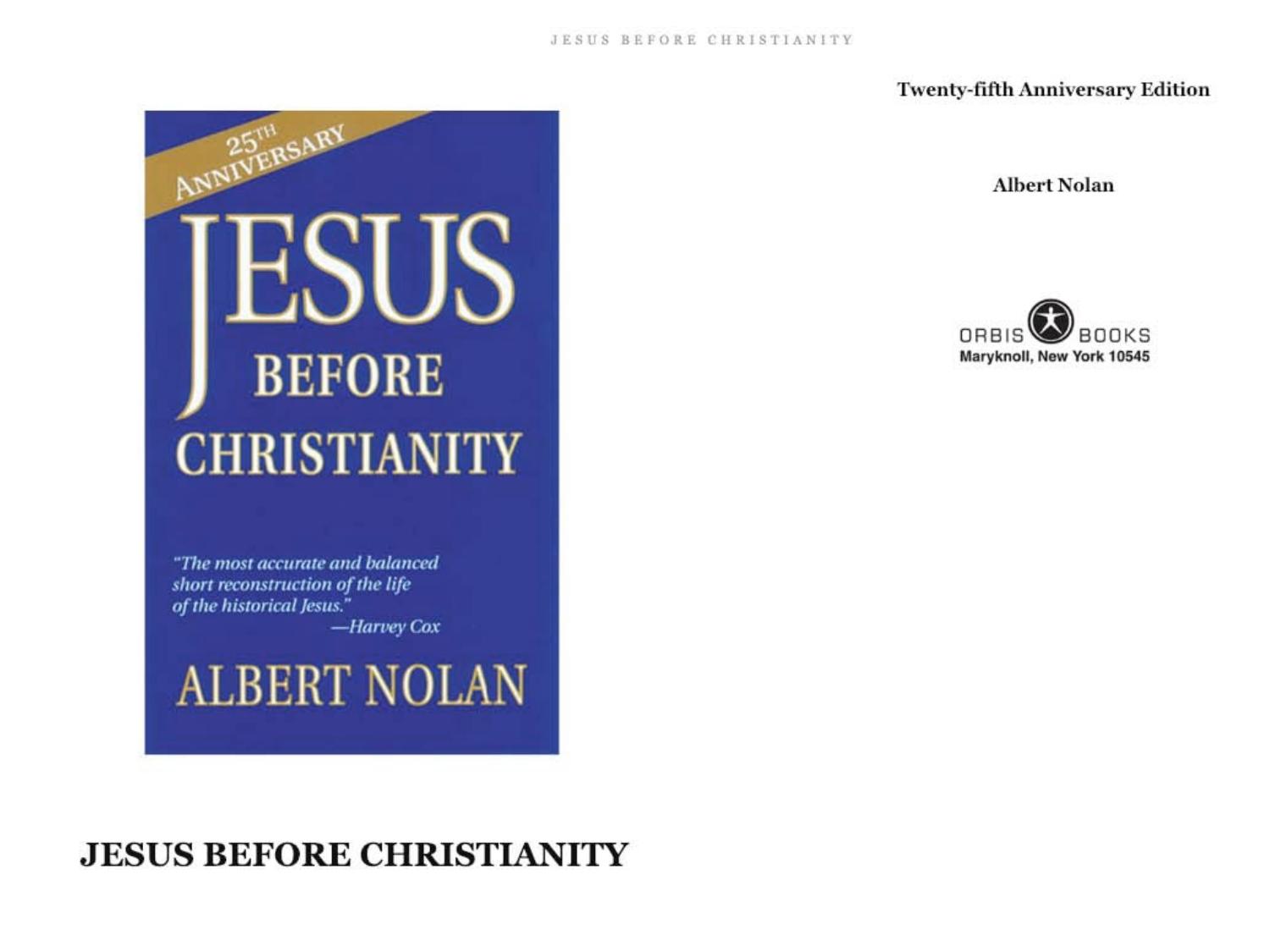
Author:Albert Nolan
Language: eng
Format: epub, pdf
Chapter 17: The Man Who Emerges
Jesus is a much underrated man—underrated not only by those who think of him as nothing more than a teacher of religious truth, but also by those who go to the opposite extreme of emphasizing his divinity in such a way that he ceases to be fully human. When one allows Jesus to speak for himself and when one tries to understand him without any preconceived ideas and within the context of his own times, what begins to emerge is a man of extraordinary independence, immense courage1 and unparalleled authenticity—a man whose insight defies explanation. To deprive this man of his humanity is to deprive him of his greatness.
It is difficult for us to imagine what it must have been like to differ radically from everybody else, past and present, in an age when group conformity was the only measure of truth and virtue. The immense learning of the scribes did not impress Jesus. He differed from them without hesitation even when they were far more knowledgeable about the details of the law and its traditional interpretation than he was. No tradition was too sacred to be questioned. No authority was too great to be contradicted. No assumption was too fundamental to be changed.
There is nothing in the gospels that would lead one to think that Jesus opposed everyone in a spirit of rebellion for the sake of rebellion or because he had a grudge against the world. He gives the impression throughout of a man who has the courage
of his convictions, a man who is independent of others because of a positive insight which has made every possible kind of dependency superfluous.
There are no traces of fear in Jesus. He was not afraid of creating a scandal or losing his reputation or even losing his life. All the men of religion, even John the Baptist, were scandalized by the way he mixed socially with sinners, by the way he seemed to enjoy their company, by his permissiveness with regard to the laws, by his apparent disregard for the seriousness of sin and by his free and easy way of treating God. He soon acquired what we would call a bad reputation: “Look, a glutton and a drunkard.” He himself relates this with what seems to be a touch of humor (Mt 11:16-19). In terms of group solidarity his friendship with sinners would classify him as a sinner (Mt 11:19; Jn 9:24). In an age when friendliness toward any woman outside of one’s family could mean only one thing, his friendship with women and especially with prostitutes would have ruined whatever reputation he still had (Lk 7:39; Jn 4:27). Jesus did nothing and compromised on nothing for the sake of even a modicum of prestige in the eyes of others. He did not seek anyone’s approval, not even the approval of “the greatest man born of woman.”
According to Mark (followed by Matthew and Luke) even Jesus’ opponents admit that he is honest and fearless: “We
Download
This site does not store any files on its server. We only index and link to content provided by other sites. Please contact the content providers to delete copyright contents if any and email us, we'll remove relevant links or contents immediately.
The Secret Power of Speaking God's Word by Joyce Meyer(3253)
Signature in the Cell: DNA and the Evidence for Intelligent Design by Stephen C. Meyer(3143)
Real Sex by Lauren F. Winner(3031)
The Holy Spirit by Billy Graham(2963)
The Gnostic Gospels by Pagels Elaine(2538)
Jesus by Paul Johnson(2373)
Devil, The by Almond Philip C(2340)
23:27 by H. L. Roberts(2260)
The Nativity by Geza Vermes(2236)
Chosen by God by R. C. Sproul(2174)
All Things New by John Eldredge(2169)
Angels of God: The Bible, the Church and the Heavenly Hosts by Mike Aquilina(1973)
The Return of the Gods by Erich von Daniken(1950)
Angels by Billy Graham(1932)
Knowing God by J.I. Packer(1863)
Jesus of Nazareth by Joseph Ratzinger(1824)
The Gnostic Gospel of St. Thomas by Tau Malachi(1806)
Evidence of the Afterlife by Jeffrey Long(1797)
How To Be Born Again by Billy Graham(1791)
